
Randall S Davis, Departments of Medicine, Microbiology, and Biochemistry & Molecular Genetics, and the O’Neal Comprehensive Cancer Center, University of Alabama at Birmingham, Birmingham, AL35294, USA
May 15, 2026 | 15h30 | CIBIO’s Auditorium and Online (Zoom Link; Passcode: 332211)
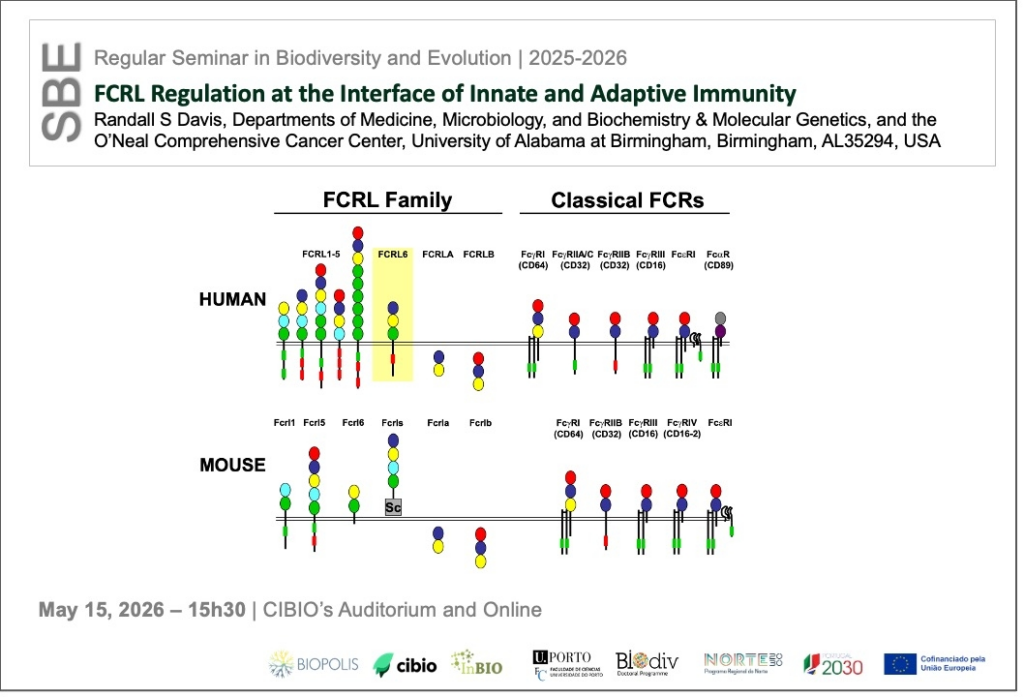
Our research is chiefly focused on members the Fc receptor-like (FCRL) gene family, which encode transmembrane glycoproteins with complex tyrosine-based signaling properties that are restricted to lymphocytes and bind Ig and MHC molecules. The physiologic roles of FCRL family members have not been extensively studied and little is known about their influence on disease pathogenesis. This is partly due to their interspecies diversity and the limited availability of in vivo models. Thus, investigating the comparative immunology and evolution of these genes may hold important clues into their roles at the interface of innate and adaptive immune defense. We will highlight the discovery of the FCRLs in the context of other multigene families, which encode receptors that balance positive and negative regulatory signals, critical to the initiation, duration, and resolution of immune responses. While human FCRL1-5 are preferentially expressed by antibody-producing B lymphocytes, this presentation will discuss FCRL6, a type I transmembrane glycoprotein that is not expressed on B cells but rather is restricted to cytotoxic T and natural killer (NK) effector lymphocytes. These cells are important for cell-based tissue surveillance and rejection in viral infection, cancer, and transplantation. We found that FCRL6 binds HLA/MHC class II, a critical polygenic polymorphic receptor component that is fundamental for antigen presentation in adaptive immunity. However, our understanding of the specific nature and functional impact of the FCRL6 relationship with HLAII is inadequate. Experiments investigating the relevance of interactions between FCRL6 and its HLAII ligand will be shown in binding, cell-reporter, and cytotoxicity assays. These studies collectively support an inhibitory influence for FCRL6 in T and NK cells upon encountering HLAII-expressing cells and indicate an unappreciated role for this axis in mechanisms of immune evasion and tolerance.
More information here