Skip to content
  • Departamento
  • Ensino
  • Estudar
  • Investigação
  • Notícias
Menu
  • Departamento
  • Ensino
  • Estudar
  • Investigação
  • Notícias
Procurar
Close this search box.

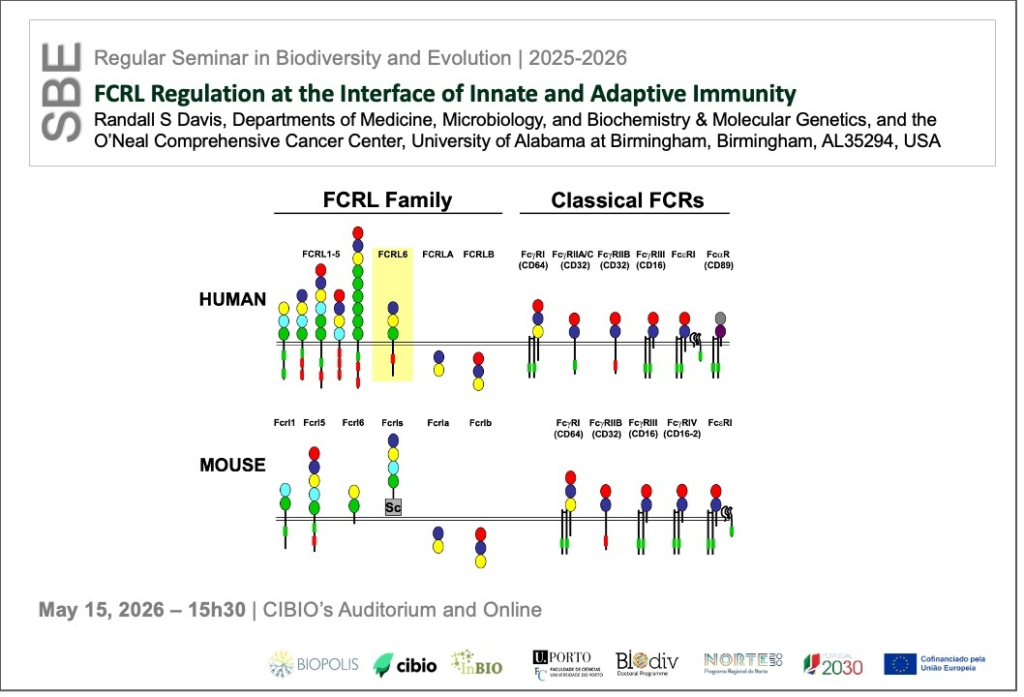
FCRL Regulation at the Interface of Innate and Adaptive Immunity

  • Maio 7, 2026
  • Eventos

Randall S Davis, Departments of Medicine, Microbiology, and Biochemistry & Molecular Genetics, and the O’Neal Comprehensive Cancer Center, University of Alabama at Birmingham, Birmingham, AL35294, USA

May 15, 2026 | 15h30 | CIBIO’s Auditorium and Online (Zoom Link; Passcode:   332211)

Our research is chiefly focused on members the Fc receptor-like (FCRL) gene family, which encode transmembrane glycoproteins with complex tyrosine-based signaling properties that are restricted to lymphocytes and bind Ig and MHC molecules. The physiologic roles of FCRL family members have not been extensively studied and little is known about their influence on disease pathogenesis. This is partly due to their interspecies diversity and the limited availability of in vivo models. Thus, investigating the comparative immunology and evolution of these genes may hold important clues into their roles at the interface of innate and adaptive immune defense. We will highlight the discovery of the FCRLs in the context of other multigene families, which encode receptors that balance positive and negative regulatory signals, critical to the initiation, duration, and resolution of immune responses. While human FCRL1-5 are preferentially expressed by antibody-producing B lymphocytes, this presentation will discuss FCRL6, a type I transmembrane glycoprotein that is not expressed on B cells but rather is restricted to cytotoxic T and natural killer (NK) effector lymphocytes. These cells are important for cell-based tissue surveillance and rejection in viral infection, cancer, and transplantation. We found that FCRL6 binds HLA/MHC class II, a critical polygenic polymorphic receptor component that is fundamental for antigen presentation in adaptive immunity. However, our understanding of the specific nature and functional impact of the FCRL6 relationship with HLAII is inadequate. Experiments investigating the relevance of interactions between FCRL6 and its HLAII ligand will be shown in binding, cell-reporter, and cytotoxicity assays. These studies collectively support an inhibitory influence for FCRL6 in T and NK cells upon encountering HLAII-expressing cells and indicate an unappreciated role for this axis in mechanisms of immune evasion and tolerance.

More information here

PrevAnteriorPrincípios da Investigação em Proteómica de Elevado Rendimento
SeguinteeDNA Week 2026 WorkshopNext

Outras notícias

Soluções Baseadas na Natureza para Controlo da Erosão dos Solos

No âmbito do projeto NBS4KTT – Nature-Based Solutions for Knowledge and Technology Transfer, a Porto Business School e a Estação Biológica de Mértola convidam-no(a) a participar no

21 de Setembro, 2026

Integrating transport and energy infrastructures and wildlife conservation: Planning, Monitoring, and Mitigation Strategies

ADVANCED COURSE: October 19-22, 2026 | Face-to-face This course explores the dynamic intersection of energy and transport infrastructure development and wildlife conservation. Participants will learn how to promote

17 de Setembro, 2026

From Raw Reads to Variants: Detecting SNPs within the Wolf Genome

Arkadiusz Dziech, Wrocław University of Environmental and Life Sciences, Poland September 25, 2026 | 14h30 | CIBIO’s Auditorium and Online (Zoom Link) Understanding the genomic landscape of the

17 de Setembro, 2026

Out of Africa: deforestation effects on avian malaria and associated viruses

Ravinder Sehgal, Dept. of Biology, San Francisco State University September 09, 2026 | 14h15 | Hybrid Seminar (Zoom Link) Deforestation driven by the expansion of oil palm plantations

7 de Setembro, 2026

Informação Geoespacial – Gestão, Análise e Aplicações

Brevemente, mais uma edição do curso de Informação Geoespacial – Gestão, Análise e Aplicações estará de volta ao CIIMAR.  Este curso oferece uma introdução prática

3 de Agosto, 2026

Molecular mechanisms of metal hyperaccumulation in Arabidopsis halleri

Marc Hanikenne, University of Liège – Department of Life Sciences July 28, 2026 | 16h00 | Hybrid Seminar (Zoom Link) Metal hyperaccumulation is one of the most remarkable

14 de Julho, 2026
DEPARTAMENTO
  • Departamento
  • Instalações
  • Herança
  • Corpo docente
  • Corpo não docente
  • Contactos
  • Departamento
  • Instalações
  • Herança
  • Corpo docente
  • Corpo não docente
  • Contactos
ENSINO
  • Licenciaturas
  • Mestrados
  • Doutoramentos
  • Formação contínua
  • Licenciaturas
  • Mestrados
  • Doutoramentos
  • Formação contínua
INVESTIGAÇÃO
  • Áreas de Investigação
  • Centros Associados
  • Áreas de Investigação
  • Centros Associados
ESTUDAR
  • Estudar
  • Testemunhos
  • Estudar
  • Testemunhos
NOTÍCIAS E EVENTOS
  • Notícias e eventos
  • Biologia fim da tarde
  • Notícias e eventos
  • Biologia fim da tarde
LINKS ÚTEIS
  • Universidade do Porto
  • Faculdade de Ciências
  • DBIO Sigarra
  • NEBUP
  • Universidade do Porto
  • Faculdade de Ciências
  • DBIO Sigarra
  • NEBUP

© 2021 Departamento de Biologia da FCUP. Design by Glitz Design

Facebook-f Twitter Instagram Linkedin Youtube