Skip to content
  • Departamento
  • Ensino
  • Estudar
  • Investigação
  • Notícias
Menu
  • Departamento
  • Ensino
  • Estudar
  • Investigação
  • Notícias
Procurar
Close this search box.

ADVANCED COURSE: 

  • Março 4, 2026
  • Eventos

Conservation Genetics: Fundaments and Applications
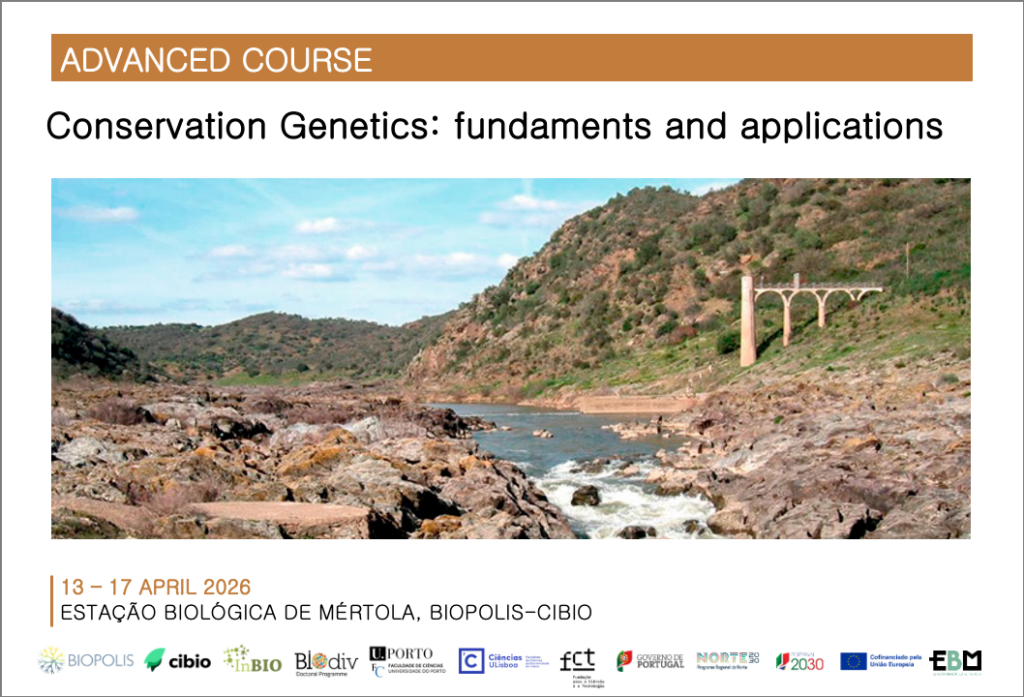
Conservation Genetics: Fundaments and Applications is a comprehensive 5-day workshop designed for postgraduate students to provide advanced understanding of genetic diversity in natural populations and its critical role in conservation of threatened species and populations.

Dates: April 13 – 17, 2026

Location: Mértola, Portugal

This intensive course will feature expert-led lectures and practical group work, promoting informal discussions, on a range of topics including:

  • Genetic Variation & Conservation: Understand the importance of genetic diversity and explore cutting-edge molecular techniques for genetic monitoring.
  • Fundaments of Population Genetics: Understand concepts such asHardy-Weinberg proportions, effective population size, inbreeding depression, genetic drift, selection.
  • Molecular Methods in Conservation: Learn about application of high-throughput sequencing methods in conservation, and methods for genetic monitoring using non-invasive sampling.
  • Anthropogenic Hybridization and Genetic Rescue. Methods for detecting anthropogenichybridization, case studies, and use of genomics in conservation of highly threatened species.

Pre-requisites: Participants are expected to have completed an introductory genetics course or possess equivalent background knowledge.

The course is organized by Dr. Soraia Barbosa and Prof. Paulo C. Alves, with invited guests:

·       Prof. Matthew P. Hare (Cornell University)

·       Prof. Jeremy Searle (Cornell University)

The course will also feature a half-day field trip to Parque Natural do Vale do Guadiana.

This is an excellent opportunity to gain valuable insights, collaborate with peers, and enhance your expertise in the field of conservation genetics.

Registration Details: https://www.cibio.up.pt/en/events/conservation-genetics-fundaments-and-applications-2/

We look forward to your participation!

PrevAnteriorMértola Evolution Conferences– 2026 edition: Natural Selection in the Wild | 17-19 April 2026
SeguintePorquê que as cobras conseguem sobreviver meses sem comer?Next

Outras notícias

Successful recovery of Eurasian lynx population in the Dinaric Mountains and Southeastern Alps

Do we need biologists to conserve cultural heritage? Fernando Carrera, Independent Researcher March 27, 2026 | 15h30 | CIBIO’s Auditorium and Online (Zoom Link; Passcode:   332211) Conservation is an essentially

24 de Março, 2026

“Sou formado em Biologia, e agora?”

Caros estudantes,   No próximo 19 de março, a FCUP promove a 1.ª edição das Alumni Talks, subordinada ao tema “Sou formado em Biologia, e

13 de Março, 2026

From Environmental Clues to Wildlife Monitoring: The Power of eDNA

ADVANCED COURSE:  From Environmental Clues to Wildlife Monitoring: The Power of eDNA May 18-22, 2026 | Face-to-face This course introduces the core concepts and techniques of environmental

13 de Março, 2026

Field Expedition Fundamentals, including Outdoor First Aid Certification

ADVANCED COURSE:  Field Expedition Fundamentals, including Outdoor First Aid Certification April 21-23, 2026 | Face-to-face This is a 3-day course composed of two modules. The first part

13 de Março, 2026

DNA METABARCODING: How to analyze next-generation sequencing data for biodiversity monitoring

DNA metabarcoding is now widely used to explore biodiversity patterns and food webs across diverse habitats and ecosystems. This method enables the identification of multiple

13 de Março, 2026

Porquê que as cobras conseguem sobreviver meses sem comer?

As cobras são conhecidas pela sua capacidade impressionante de sobreviver durante longos períodos sem comer. Agora, um novo estudo internacional, publicado na Royal Society Open

13 de Março, 2026
DEPARTAMENTO
  • Departamento
  • Instalações
  • Herança
  • Corpo docente
  • Corpo não docente
  • Contactos
  • Departamento
  • Instalações
  • Herança
  • Corpo docente
  • Corpo não docente
  • Contactos
ENSINO
  • Licenciaturas
  • Mestrados
  • Doutoramentos
  • Formação contínua
  • Licenciaturas
  • Mestrados
  • Doutoramentos
  • Formação contínua
INVESTIGAÇÃO
  • Áreas de Investigação
  • Centros Associados
  • Áreas de Investigação
  • Centros Associados
ESTUDAR
  • Estudar
  • Testemunhos
  • Estudar
  • Testemunhos
NOTÍCIAS E EVENTOS
  • Notícias e eventos
  • Biologia fim da tarde
  • Notícias e eventos
  • Biologia fim da tarde
LINKS ÚTEIS
  • Universidade do Porto
  • Faculdade de Ciências
  • DBIO Sigarra
  • NEBUP
  • Universidade do Porto
  • Faculdade de Ciências
  • DBIO Sigarra
  • NEBUP

© 2021 Departamento de Biologia da FCUP. Design by Glitz Design

Facebook-f Twitter Instagram Linkedin Youtube