Skip to content
  • Departamento
  • Ensino
  • Estudar
  • Investigação
  • Notícias
Menu
  • Departamento
  • Ensino
  • Estudar
  • Investigação
  • Notícias
Procurar
Close this search box.

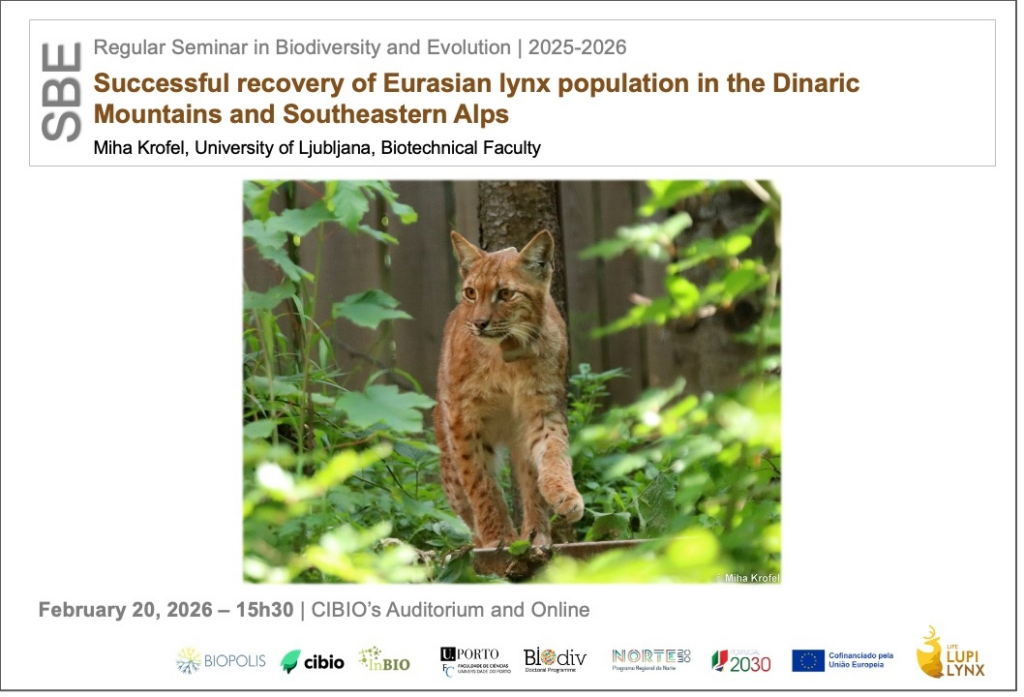
BIOPOLIS/CIBIO-InBIO REGULAR SEMINAR | Successful recovery of Eurasian lynx population in the Dinaric Mountains and Southeastern Alps | February 20, 2026- 15h30

  • Fevereiro 12, 2026
  • Eventos

Successful recovery of Eurasian lynx population in the Dinaric Mountains and Southeastern Alps

Miha Krofel, University of Ljubljana, Biotechnical Faculty

February 20, 2026 | 15h30 | CIBIO’s Auditorium and Online (Zoom Link; Passcode:   332211)

Eurasian lynx is the largest cat in Europe, but high inbreeding levels and illegal killings threaten its survival in Central Europe. To prevent extinction of the highly-inbred and declining Dinaric population and to reintroduce lynx in the Southeastern Alps, we carried out a large-scale conservation programme between 2017 and 2023. This included translocation of 22 wild-caught lynx from the Carpathian Mountains to Slovenia, Croatia and Italy. Throughout the process, we closely monitored the effects of the translocations on the lynx population, on local ecosystems and on the public support for lynx conservation. In this seminar we will go through the impacts of these translocations and provide an overview of the approaches used. Most of the translocated lynx successfully integrated into the local population and reproduced. Post-release movements were partly related to the translocation method (soft-release vs. hard release) and presence of the conspecifics in the release areas. More than 50 lynx kittens born to translocated parents were already detected and average litter size increasing by 37% compared to the lynx from the remnant population. Translocated lynx also rapidly resumed key ecological roles, including predation of herbivore populations and supporting 20 species of vertebrate scavengers by providing food subsidues in the form of prey remains. We also observed several population-level effects of translocations. Namely, the population decline was reversed and lynx densities increased by 44% in the first four years. Also inbreeding was dramatically reduced, with up to a four-fold increase in individual fitness. Transparent communication and strong cooperation with hunters and local communities helped maintain high public support throughout the process. Together, these findings show that genetic rescue, science-based management, and inclusive stakeholder engagement can deliver real conservation success, even in human-dominated landscapes like Central Europe.

More information here

PrevAnteriorBIOPOLIS/CIBIO-InBIO ADVANCED COURSE: Introduction to R Programming for Biological Data Analysis | Application deadline: March 13, 2026
Seguinte28ª edição do curso Cal-AquaNext

Outras notícias

Programa Blue Young Talent 2026

O Centro Interdisciplinar de Investigação Marinha e Ambiental da Universidade do Porto (CIIMAR) informa que se encontram abertas as candidaturas para a edição de 2026

17 de Abril, 2026

Rethinking Boreal Rainforest Biogeography: Cryptogam Evidence from Western Scandinavia

Rethinking Boreal Rainforest Biogeography: Cryptogam Evidence from Western Scandinavia Raúl Vicente, Pro Natura Foundation April 24, 2026 | 15h30 | CIBIO’s Auditorium and Online (Zoom Link; Passcode:   332211) How do

16 de Abril, 2026

Estatística Multivariada com R para as Ciências Biológicas

A próxima edição do curso ‘Estatística Multivariada com R para as Ciências Biológicas‘, organizado pelo CIIMAR, decorrerá entre os dias 11 e 15 de maio, 2026.

15 de Abril, 2026

Glimpses of Coastal and Island Marine Biodiversity of India

Preeti Pereira, School of Biological Sciences and Biotechnology, Goa University April 14, 2026 | 14h00 | Hybrid Seminar (Zoom Link) Overview of the coastal and marine biodiversity of

13 de Abril, 2026

SINGLE CELL OMICS E
MEDICINA DE PRECISÃO NA ERA
DA INTELIGÊNCIA ARTIFICIAL

Seminário | Eduardo da Veiga Beltrame 7 de abril 2026 | FC5 2.78 Uma das consequências mais empolgantes da acessibilidade das tecnologias desingle cell omics

1 de Abril, 2026

Para Além do Laboratório: A descoberta de um caminho na Comunicação de Ciência

15 de abril de 2026 às 16 horas | Auditório da Biblioteca da FCUP A ciência não vive só no laboratório, vive nas conversas que

1 de Abril, 2026
DEPARTAMENTO
  • Departamento
  • Instalações
  • Herança
  • Corpo docente
  • Corpo não docente
  • Contactos
  • Departamento
  • Instalações
  • Herança
  • Corpo docente
  • Corpo não docente
  • Contactos
ENSINO
  • Licenciaturas
  • Mestrados
  • Doutoramentos
  • Formação contínua
  • Licenciaturas
  • Mestrados
  • Doutoramentos
  • Formação contínua
INVESTIGAÇÃO
  • Áreas de Investigação
  • Centros Associados
  • Áreas de Investigação
  • Centros Associados
ESTUDAR
  • Estudar
  • Testemunhos
  • Estudar
  • Testemunhos
NOTÍCIAS E EVENTOS
  • Notícias e eventos
  • Biologia fim da tarde
  • Notícias e eventos
  • Biologia fim da tarde
LINKS ÚTEIS
  • Universidade do Porto
  • Faculdade de Ciências
  • DBIO Sigarra
  • NEBUP
  • Universidade do Porto
  • Faculdade de Ciências
  • DBIO Sigarra
  • NEBUP

© 2021 Departamento de Biologia da FCUP. Design by Glitz Design

Facebook-f Twitter Instagram Linkedin Youtube