
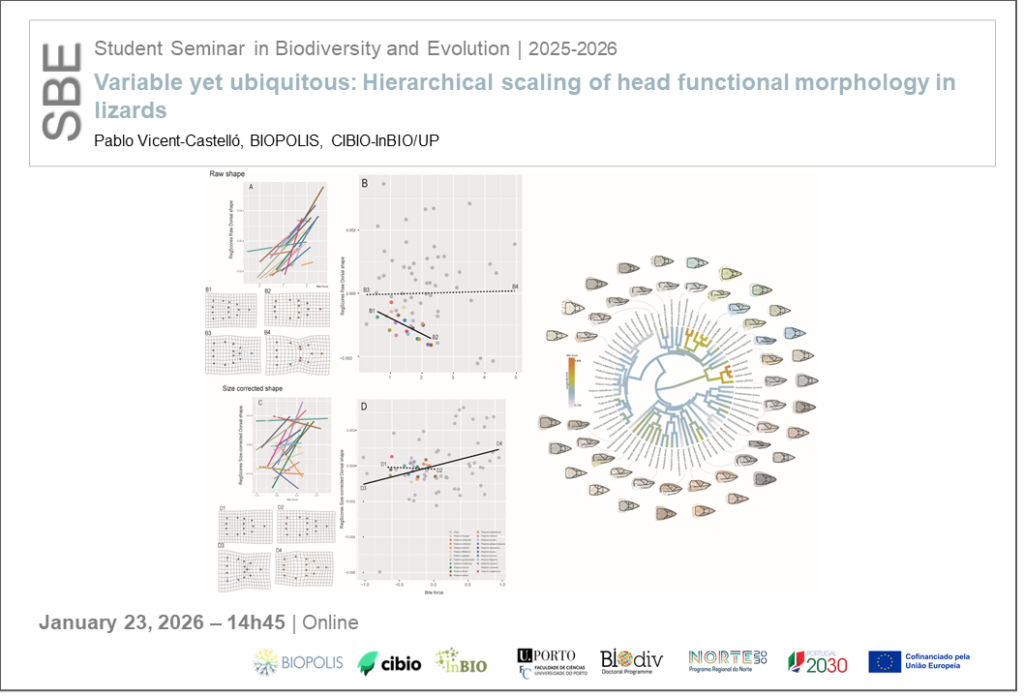
Variable yet ubiquitous: Hierarchical scaling of head functional morphology in lizards
Pablo Vicent-Castelló, BIOPOLIS, CIBIO-InBIO/UP
January 23, 2026 | 14h45 | ONLINE (Zoom Link; Passcode:1122)
Understanding how form–function relationships scale across levels of biological organization is essential for uncovering the mechanisms driving morphological and performance diversity. We examined the association between head shape and bite force in lacertid lizards across three hierarchical levels: individuals within species, species within the genus Podarcis, and species across the family Lacertidae. Using geometric morphometrics of dorsal and lateral head shape combined with bite force measurements, we tested whether the strength and direction of the form–function relationship is conserved across scales and whether body size mediates these patterns. Our analyses revealed significant associations between head shape and bite force at all levels, with body size exerting a strong but not exclusive influence. Importantly, while the form–function link persisted after correcting for size, the evolutionary trajectories of this relationship were not aligned across scales: regression vectors differed randomly rather than following consistent directions. These results indicate that performance consistently constrains head morphology, yet the evolutionary pathways linking form and function vary across scales, reflecting a flexible interplay between selective pressures, developmental constraints, and phylogenetic history.
More information here