Skip to content
  • Departamento
  • Ensino
  • Estudar
  • Investigação
  • Notícias
Menu
  • Departamento
  • Ensino
  • Estudar
  • Investigação
  • Notícias
Procurar
Close this search box.

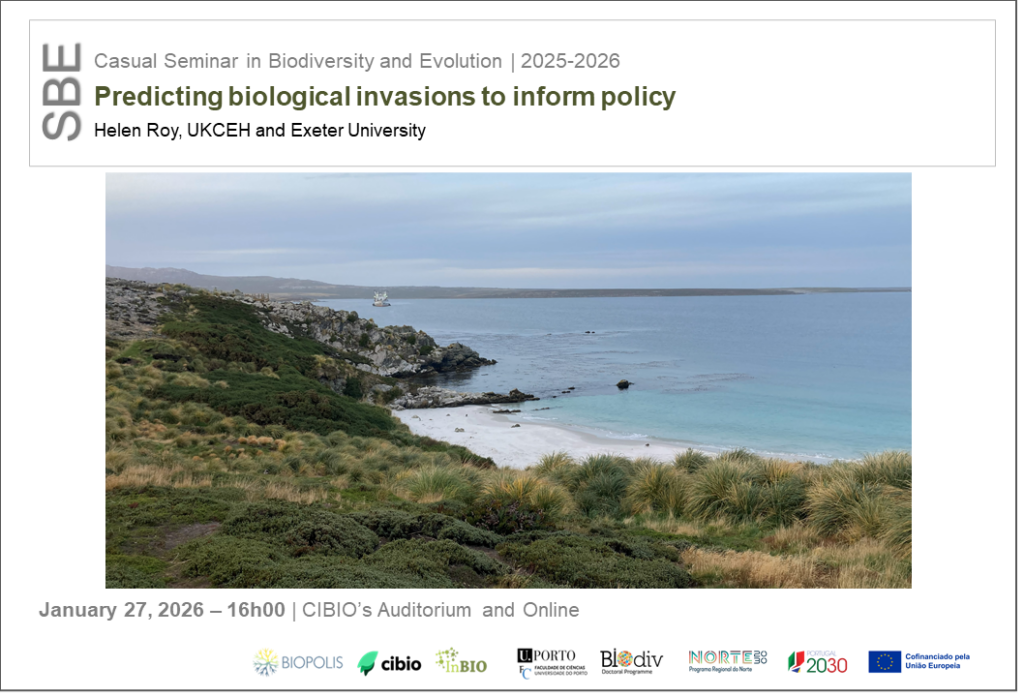
BIOPOLIS/CIBIO-InBIO CASUAL SEMINAR | Predicting biological invasions to inform policy | January 27, 2026- 16h00

  • Janeiro 20, 2026
  • Eventos

Predicting biological invasions to inform policy

Helen Roy, UKCEH and Exeter University

January 27, 2026 | 16h00 | Hybrid Seminar (Zoom Link; Passcode:1122)

Invasive alien species are a major and growing threat to people and nature. Target 6 of the Global Biodiversity Framework (GBF) commits nations to reduce the introduction of INNS by 50 percent and minimize their impact. Effective biosecurity, and specifically preventing the arrival of invasive alien species, is critical to achieving Target 6. Enhancing knowledge and data flows on invasive alien species is important to inform action and policy. Reliable and open information is essential to track progress towards Target 6 of the GBF while ensuring priorisation and evaluation of action through, as an example, horizon scanning. Collaborative horizon scanning studies, combining impact assessments and expert elicitation, are used to inform biosecurity by providing predictions about which species might be the most likely to arrive and impact biodiversity and ecosystems in the future. We have applied horizon scanning to inform prioritisation of preventative actions for invasive alien species in Britain, Europe and across the UK Overseas Territories. Here I will provide an overview of the approach highlighting the need for information and the importance of effective data flows to inform horizon scanning (and for many other purposes). I will describe the ways in which we have been enhancing information flows and the outcomes from horizon scanning, specifically linking to awareness raising, early warning and rapid response to ultimately mitigate the impacts of invasive alien species. Curbing the threat of invasive alien species is urgent but achievable. 

More information here

PrevAnteriorBIOPOLIS/CIBIO-InBIO ADVANCED COURSE: Conservation Genetics: Fundaments and Applications | Application deadline: March 01, 2026
SeguinteBIOPOLIS/CIBIO-InBIO STUDENT SEMINAR | Variable yet ubiquitous: Hierarchical scaling of head functional morphology in lizards | January 23, 2026- 14h45Next

Outras notícias

Decoding Alignment-Independent Retinal Regulatory Codes in Vertebrate Genomes

Yohei Ogawa, Molecular Life History Laboratory, National Institute of Genetics, Japan July 17, 2026 | 15h30 | CIBIO’s Auditorium and Online (Zoom Link) Homologous cell types have been

9 de Julho, 2026

Saving the Dinaric Eurasian lynx population from extinction

Magda Sindičić, Associate Professor, Faculty of Veterinary Medicine – University of Zagreb July 15, 2026 | 15h00 | Hybrid Seminar (Zoom Link) Central European populations of Eurasian lynx

1 de Julho, 2026

Como organizar eventos sustentáveis

Na sequência da publicação do “Guia sobre Como Organizar Eventos Sustentáveis” do CIIMAR, o Gabinete de Sustentabilidade Social e Ambiental irá organizar um seminário para

18 de Junho, 2026

Southeast Asian Biogeography Revisited: Alternative Mechanisms of Diversification and Dispersal

Justin Bernstein, American Museum of Natural History July 21, 2026 | 15h00 | Hybrid Seminar (Zoom Link) This presentation explores how geological and environmental processes shaped snake diversity

18 de Junho, 2026

Regulation of developmental plasticity in spadefoot toad larvae and its phenotypic consequences

Ivan Gomez Mestre, Estación Biológica de Doñana, CSIC June 17, 2026 | 10h30 | Hybrid Seminar (Zoom Link) Amphibians have evolved the greatest diversity of reproductive modes across tetrapods.

17 de Junho, 2026

Combining Physiology with Other Disciplines to Prevent Climate-Driven Wildlife Extirpation

Agustín Camacho, Facultad de Ciencias, Universidad Autónoma de Madrid June 17, 2026 | 15h00 | Hybrid Seminar (Zoom Link) Many different scientific disciplines and techniques claim to be key

12 de Junho, 2026
DEPARTAMENTO
  • Departamento
  • Instalações
  • Herança
  • Corpo docente
  • Corpo não docente
  • Contactos
  • Departamento
  • Instalações
  • Herança
  • Corpo docente
  • Corpo não docente
  • Contactos
ENSINO
  • Licenciaturas
  • Mestrados
  • Doutoramentos
  • Formação contínua
  • Licenciaturas
  • Mestrados
  • Doutoramentos
  • Formação contínua
INVESTIGAÇÃO
  • Áreas de Investigação
  • Centros Associados
  • Áreas de Investigação
  • Centros Associados
ESTUDAR
  • Estudar
  • Testemunhos
  • Estudar
  • Testemunhos
NOTÍCIAS E EVENTOS
  • Notícias e eventos
  • Biologia fim da tarde
  • Notícias e eventos
  • Biologia fim da tarde
LINKS ÚTEIS
  • Universidade do Porto
  • Faculdade de Ciências
  • DBIO Sigarra
  • NEBUP
  • Universidade do Porto
  • Faculdade de Ciências
  • DBIO Sigarra
  • NEBUP

© 2021 Departamento de Biologia da FCUP. Design by Glitz Design

Facebook-f Twitter Instagram Linkedin Youtube