Skip to content
  • Departamento
  • Ensino
  • Estudar
  • Investigação
  • Notícias
Menu
  • Departamento
  • Ensino
  • Estudar
  • Investigação
  • Notícias
Procurar
Close this search box.

BIOPOLIS/CIBIO-InBIO STUDENT SEMINAR | Alarming low breeding success in two declining steppe birds revealed by remote tracking and field data | October 11, 2024 – 14h45

  • Outubro 8, 2024
  • Eventos

Alarming low breeding success in two declining steppe birds revealed by remote tracking and field data

Gonçalo Ferraz, BIOPOLIS, CIBIO-InBIO/UP

October 11, 2024 | 14h45 | Online
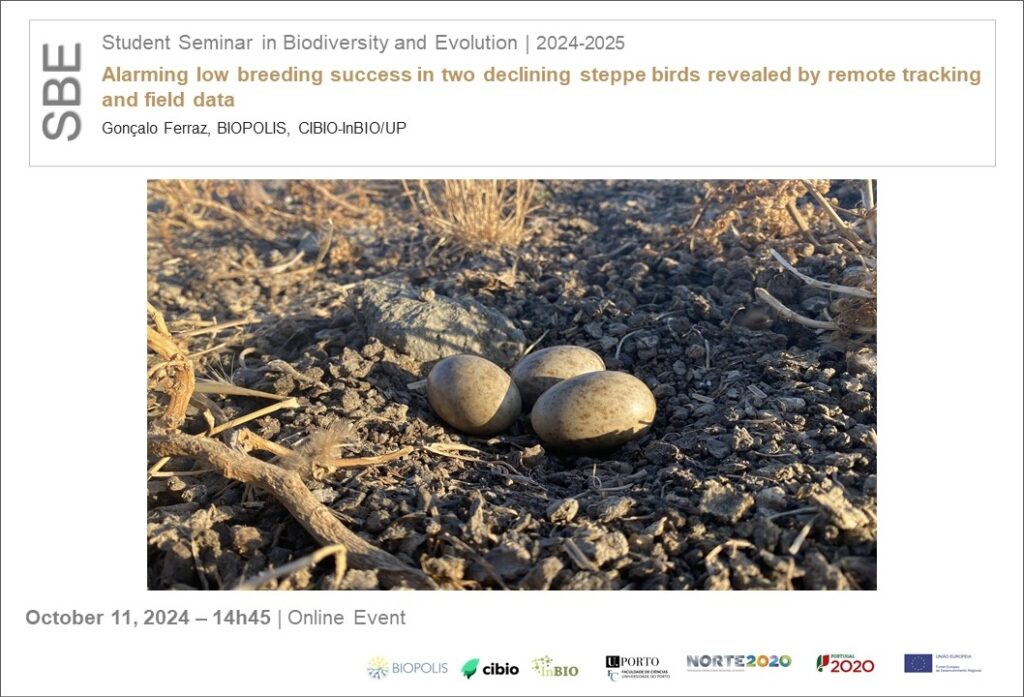
The Iberian Peninsula is an important European stronghold for steppe birds. These species are particularly vulnerable to habitat changes primarily caused by agricultural intensification and industrial land conversion. Despite alarming population declines, key demographic parameters, such as productivity, remain unknown for most species. Assessing reproductive success and the main causes of breeding failure is crucial for understanding these declines. Many species, like sandgrouses, are not only elusive and difficult to survey but also ground nesting and vulnerable to predation and nest destruction during farming activities. Here, we used remote tracking (GPS and accelerometer) and field data to study the reproductive biology of the black-bellied (Pterocles orientalis) and pin-tailed sandgrouse (Pterocles alchata) in the Iberian Peninsula.Combining remote nest detection with fieldwork, we monitored the breeding of both species for three years (2021-2023) in two populations of south-central Iberia, enhancing our understanding of their breeding success and the variables influencing it. We remotely monitored 76 P. orientalis and 56 P. alchata breeding attempts and conducted fieldwork to check nest contents, causes of breeding failure and assess productivity. We found very low hatching success for both species (35% for P. orientalis and 28% for P. alchata), with most nests failing due to predation. Sandgrouse have an extended (6-month-long) breeding season in response to high failure rates, producing around 3 clutches per year. Overall, high nest failure and very low productivity (<0.5 chicks per pair per year) emphasize the need for effective conservation strategies to enhance productivity and halt sandgrouse population declines.

More information here

PrevAnteriorBIOPOLIS/CIBIO-InBIO CASUAL SEMINAR | Sensory Bottlenecks and Blind Alleys: Shedding Light on Reptile Sight | October 10, 2024 – 15h30
SeguinteBIOPOLIS/CIBIO-InBIO REGULAR SEMINAR | Evolution of homosexual preference in humans | October 18, 2024 – 15h30Next

Outras notícias

Decoding Alignment-Independent Retinal Regulatory Codes in Vertebrate Genomes

Yohei Ogawa, Molecular Life History Laboratory, National Institute of Genetics, Japan July 17, 2026 | 15h30 | CIBIO’s Auditorium and Online (Zoom Link) Homologous cell types have been

9 de Julho, 2026

Saving the Dinaric Eurasian lynx population from extinction

Magda Sindičić, Associate Professor, Faculty of Veterinary Medicine – University of Zagreb July 15, 2026 | 15h00 | Hybrid Seminar (Zoom Link) Central European populations of Eurasian lynx

1 de Julho, 2026

Como organizar eventos sustentáveis

Na sequência da publicação do “Guia sobre Como Organizar Eventos Sustentáveis” do CIIMAR, o Gabinete de Sustentabilidade Social e Ambiental irá organizar um seminário para

18 de Junho, 2026

Southeast Asian Biogeography Revisited: Alternative Mechanisms of Diversification and Dispersal

Justin Bernstein, American Museum of Natural History July 21, 2026 | 15h00 | Hybrid Seminar (Zoom Link) This presentation explores how geological and environmental processes shaped snake diversity

18 de Junho, 2026

Regulation of developmental plasticity in spadefoot toad larvae and its phenotypic consequences

Ivan Gomez Mestre, Estación Biológica de Doñana, CSIC June 17, 2026 | 10h30 | Hybrid Seminar (Zoom Link) Amphibians have evolved the greatest diversity of reproductive modes across tetrapods.

17 de Junho, 2026

Combining Physiology with Other Disciplines to Prevent Climate-Driven Wildlife Extirpation

Agustín Camacho, Facultad de Ciencias, Universidad Autónoma de Madrid June 17, 2026 | 15h00 | Hybrid Seminar (Zoom Link) Many different scientific disciplines and techniques claim to be key

12 de Junho, 2026
DEPARTAMENTO
  • Departamento
  • Instalações
  • Herança
  • Corpo docente
  • Corpo não docente
  • Contactos
  • Departamento
  • Instalações
  • Herança
  • Corpo docente
  • Corpo não docente
  • Contactos
ENSINO
  • Licenciaturas
  • Mestrados
  • Doutoramentos
  • Formação contínua
  • Licenciaturas
  • Mestrados
  • Doutoramentos
  • Formação contínua
INVESTIGAÇÃO
  • Áreas de Investigação
  • Centros Associados
  • Áreas de Investigação
  • Centros Associados
ESTUDAR
  • Estudar
  • Testemunhos
  • Estudar
  • Testemunhos
NOTÍCIAS E EVENTOS
  • Notícias e eventos
  • Biologia fim da tarde
  • Notícias e eventos
  • Biologia fim da tarde
LINKS ÚTEIS
  • Universidade do Porto
  • Faculdade de Ciências
  • DBIO Sigarra
  • NEBUP
  • Universidade do Porto
  • Faculdade de Ciências
  • DBIO Sigarra
  • NEBUP

© 2021 Departamento de Biologia da FCUP. Design by Glitz Design

Facebook-f Twitter Instagram Linkedin Youtube