Skip to content
  • Departamento
  • Ensino
  • Estudar
  • Investigação
  • Notícias
Menu
  • Departamento
  • Ensino
  • Estudar
  • Investigação
  • Notícias
Procurar
Close this search box.

ADVANCED COURSE: Methods in Research Synthesis: Systematic Reviews and Meta-Analysis

  • Novembro 23, 2023
  • Eventos

January 08-12, 2024 | (Face-to-face)
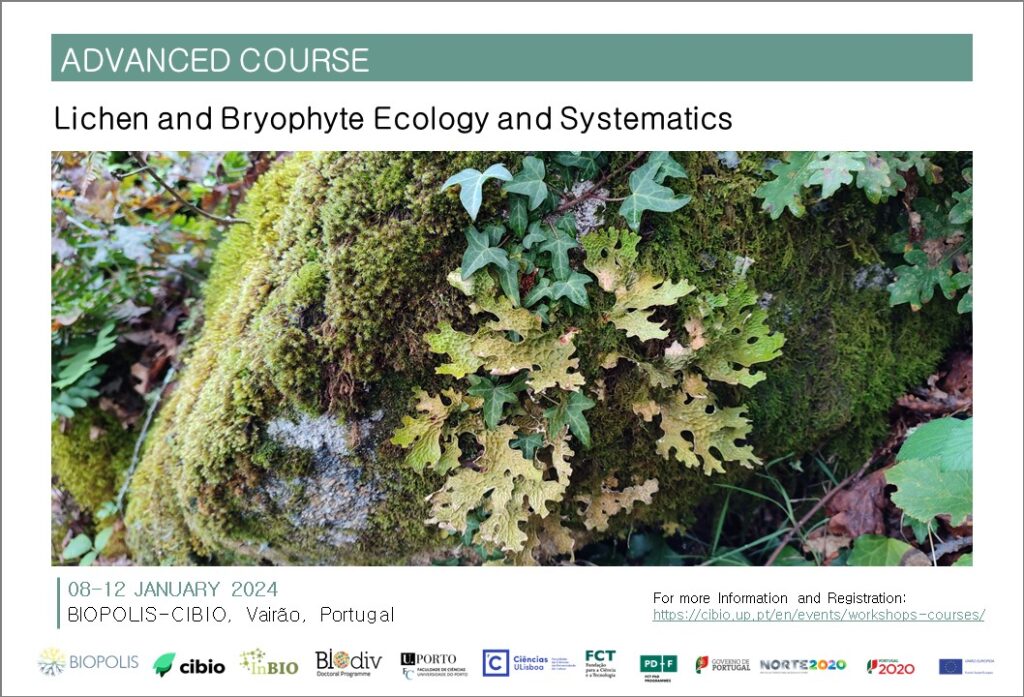
Through a combination of lectures, hands-on labs and field visits to local sites around the CIBIO-UP Campus, this course will cover major topics in lichen and bryophyte biology, ecology and evolution. An emphasis is placed on comparative lichen and bryophyte anatomy, morphology and structure as well as on ecologically key species, including those which may have important applications. Attendees are also given an overview of the incredible diversity of lichens and bryophytes and how these organisms evolved and interacted with the environment. Field visits will involve observing a range of (micro-)habitats where the specimens can be identified within their ecological context. Specimens may be taken back to the laboratory for examination and identification.

After successfully completing the course attendees are expected to:

• Understand the basic organization of the lichen and bryophyte bodies;

• Know how to collect specimens in the field and create a reference collection;

• Know how to use a lens in the field to look for characteristic structures;

• Know how to use lab equipment to analyse diagnostic structures in the lab;

• Recognize lichen and bryophyte cells, tissues and tissue systems;

• Identify basic types of lichen and bryophyte vegetative and reproductive structures;

• Interpret lichen and bryophyte structures and adaptations as responses to the environment;

• Thoroughly understand the lichen and bryophyte morphology terminology;

• Identify a selection of common species using a range of identification resources;

• Evaluate the role that lichens and bryophytes have as ecological indicators, and as reliable tools for monitoring and managing environmental changes;

• Be aware of the modern methods and approaches in biomonitoring, biodeterioration and bioprospection, and discuss how these have enhanced or changed classical approaches;

• Demonstrate knowledge in the current understanding of lichen and bryophyte phylogeny and evolution.

Application deadline: December 12, 2023

Click here for more details

PrevAnteriorPlantAnim Design Thinking Dec 18th
SeguinteESTUDO DA EVOLUÇÃO DA PAISAGEM URBANA DO PORTO FORNECE INFORMAÇÃO CHAVE PARA A CONSERVAÇÃO DE BIODIVERSIDADE URBANANext

Outras notícias

Soluções Baseadas na Natureza para Controlo da Erosão dos Solos

No âmbito do projeto NBS4KTT – Nature-Based Solutions for Knowledge and Technology Transfer, a Porto Business School e a Estação Biológica de Mértola convidam-no(a) a participar no

21 de Setembro, 2026

Integrating transport and energy infrastructures and wildlife conservation: Planning, Monitoring, and Mitigation Strategies

ADVANCED COURSE: October 19-22, 2026 | Face-to-face This course explores the dynamic intersection of energy and transport infrastructure development and wildlife conservation. Participants will learn how to promote

17 de Setembro, 2026

From Raw Reads to Variants: Detecting SNPs within the Wolf Genome

Arkadiusz Dziech, Wrocław University of Environmental and Life Sciences, Poland September 25, 2026 | 14h30 | CIBIO’s Auditorium and Online (Zoom Link) Understanding the genomic landscape of the

17 de Setembro, 2026

Out of Africa: deforestation effects on avian malaria and associated viruses

Ravinder Sehgal, Dept. of Biology, San Francisco State University September 09, 2026 | 14h15 | Hybrid Seminar (Zoom Link) Deforestation driven by the expansion of oil palm plantations

7 de Setembro, 2026

Informação Geoespacial – Gestão, Análise e Aplicações

Brevemente, mais uma edição do curso de Informação Geoespacial – Gestão, Análise e Aplicações estará de volta ao CIIMAR.  Este curso oferece uma introdução prática

3 de Agosto, 2026

Molecular mechanisms of metal hyperaccumulation in Arabidopsis halleri

Marc Hanikenne, University of Liège – Department of Life Sciences July 28, 2026 | 16h00 | Hybrid Seminar (Zoom Link) Metal hyperaccumulation is one of the most remarkable

14 de Julho, 2026
DEPARTAMENTO
  • Departamento
  • Instalações
  • Herança
  • Corpo docente
  • Corpo não docente
  • Contactos
  • Departamento
  • Instalações
  • Herança
  • Corpo docente
  • Corpo não docente
  • Contactos
ENSINO
  • Licenciaturas
  • Mestrados
  • Doutoramentos
  • Formação contínua
  • Licenciaturas
  • Mestrados
  • Doutoramentos
  • Formação contínua
INVESTIGAÇÃO
  • Áreas de Investigação
  • Centros Associados
  • Áreas de Investigação
  • Centros Associados
ESTUDAR
  • Estudar
  • Testemunhos
  • Estudar
  • Testemunhos
NOTÍCIAS E EVENTOS
  • Notícias e eventos
  • Biologia fim da tarde
  • Notícias e eventos
  • Biologia fim da tarde
LINKS ÚTEIS
  • Universidade do Porto
  • Faculdade de Ciências
  • DBIO Sigarra
  • NEBUP
  • Universidade do Porto
  • Faculdade de Ciências
  • DBIO Sigarra
  • NEBUP

© 2021 Departamento de Biologia da FCUP. Design by Glitz Design

Facebook-f Twitter Instagram Linkedin Youtube