Skip to content
  • Departamento
  • Ensino
  • Estudar
  • Investigação
  • Notícias
Menu
  • Departamento
  • Ensino
  • Estudar
  • Investigação
  • Notícias
Procurar
Close this search box.

ADVANCED COURSE: 

  • Março 4, 2026
  • Eventos

Conservation Genetics: Fundaments and Applications
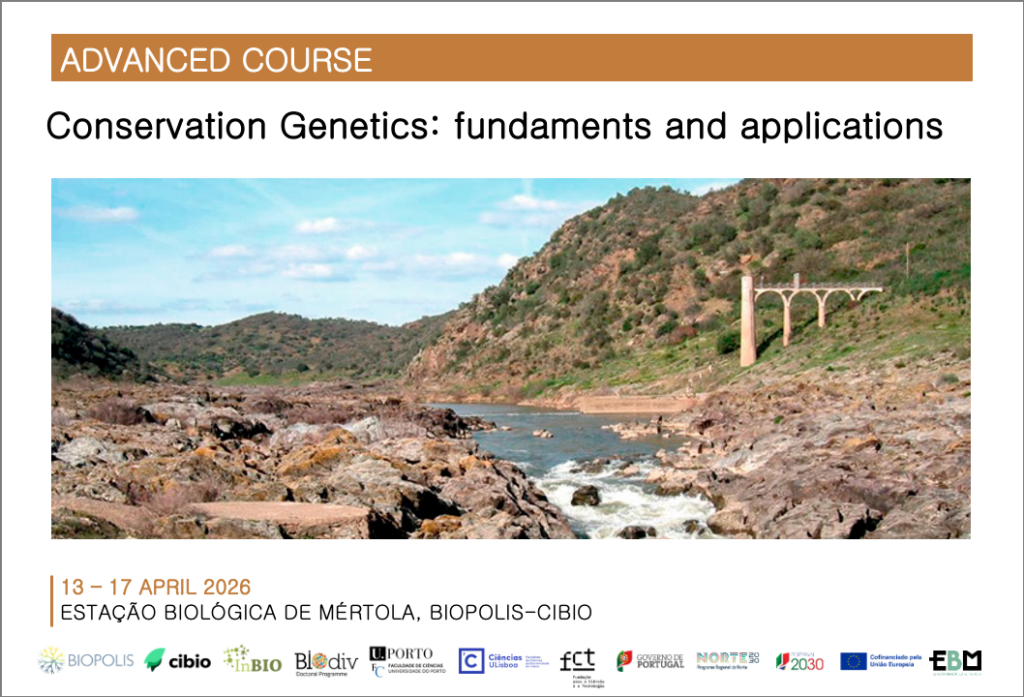
Conservation Genetics: Fundaments and Applications is a comprehensive 5-day workshop designed for postgraduate students to provide advanced understanding of genetic diversity in natural populations and its critical role in conservation of threatened species and populations.

Dates: April 13 – 17, 2026

Location: Mértola, Portugal

This intensive course will feature expert-led lectures and practical group work, promoting informal discussions, on a range of topics including:

  • Genetic Variation & Conservation: Understand the importance of genetic diversity and explore cutting-edge molecular techniques for genetic monitoring.
  • Fundaments of Population Genetics: Understand concepts such asHardy-Weinberg proportions, effective population size, inbreeding depression, genetic drift, selection.
  • Molecular Methods in Conservation: Learn about application of high-throughput sequencing methods in conservation, and methods for genetic monitoring using non-invasive sampling.
  • Anthropogenic Hybridization and Genetic Rescue. Methods for detecting anthropogenichybridization, case studies, and use of genomics in conservation of highly threatened species.

Pre-requisites: Participants are expected to have completed an introductory genetics course or possess equivalent background knowledge.

The course is organized by Dr. Soraia Barbosa and Prof. Paulo C. Alves, with invited guests:

·       Prof. Matthew P. Hare (Cornell University)

·       Prof. Jeremy Searle (Cornell University)

The course will also feature a half-day field trip to Parque Natural do Vale do Guadiana.

This is an excellent opportunity to gain valuable insights, collaborate with peers, and enhance your expertise in the field of conservation genetics.

Registration Details: https://www.cibio.up.pt/en/events/conservation-genetics-fundaments-and-applications-2/

We look forward to your participation!

PrevAnteriorMértola Evolution Conferences– 2026 edition: Natural Selection in the Wild | 17-19 April 2026
SeguintePorquê que as cobras conseguem sobreviver meses sem comer?Next

Outras notícias

Decoding Alignment-Independent Retinal Regulatory Codes in Vertebrate Genomes

Yohei Ogawa, Molecular Life History Laboratory, National Institute of Genetics, Japan July 17, 2026 | 15h30 | CIBIO’s Auditorium and Online (Zoom Link) Homologous cell types have been

9 de Julho, 2026

Saving the Dinaric Eurasian lynx population from extinction

Magda Sindičić, Associate Professor, Faculty of Veterinary Medicine – University of Zagreb July 15, 2026 | 15h00 | Hybrid Seminar (Zoom Link) Central European populations of Eurasian lynx

1 de Julho, 2026

Como organizar eventos sustentáveis

Na sequência da publicação do “Guia sobre Como Organizar Eventos Sustentáveis” do CIIMAR, o Gabinete de Sustentabilidade Social e Ambiental irá organizar um seminário para

18 de Junho, 2026

Southeast Asian Biogeography Revisited: Alternative Mechanisms of Diversification and Dispersal

Justin Bernstein, American Museum of Natural History July 21, 2026 | 15h00 | Hybrid Seminar (Zoom Link) This presentation explores how geological and environmental processes shaped snake diversity

18 de Junho, 2026

Regulation of developmental plasticity in spadefoot toad larvae and its phenotypic consequences

Ivan Gomez Mestre, Estación Biológica de Doñana, CSIC June 17, 2026 | 10h30 | Hybrid Seminar (Zoom Link) Amphibians have evolved the greatest diversity of reproductive modes across tetrapods.

17 de Junho, 2026

Combining Physiology with Other Disciplines to Prevent Climate-Driven Wildlife Extirpation

Agustín Camacho, Facultad de Ciencias, Universidad Autónoma de Madrid June 17, 2026 | 15h00 | Hybrid Seminar (Zoom Link) Many different scientific disciplines and techniques claim to be key

12 de Junho, 2026
DEPARTAMENTO
  • Departamento
  • Instalações
  • Herança
  • Corpo docente
  • Corpo não docente
  • Contactos
  • Departamento
  • Instalações
  • Herança
  • Corpo docente
  • Corpo não docente
  • Contactos
ENSINO
  • Licenciaturas
  • Mestrados
  • Doutoramentos
  • Formação contínua
  • Licenciaturas
  • Mestrados
  • Doutoramentos
  • Formação contínua
INVESTIGAÇÃO
  • Áreas de Investigação
  • Centros Associados
  • Áreas de Investigação
  • Centros Associados
ESTUDAR
  • Estudar
  • Testemunhos
  • Estudar
  • Testemunhos
NOTÍCIAS E EVENTOS
  • Notícias e eventos
  • Biologia fim da tarde
  • Notícias e eventos
  • Biologia fim da tarde
LINKS ÚTEIS
  • Universidade do Porto
  • Faculdade de Ciências
  • DBIO Sigarra
  • NEBUP
  • Universidade do Porto
  • Faculdade de Ciências
  • DBIO Sigarra
  • NEBUP

© 2021 Departamento de Biologia da FCUP. Design by Glitz Design

Facebook-f Twitter Instagram Linkedin Youtube