Skip to content
  • Departamento
  • Ensino
  • Estudar
  • Investigação
  • Notícias
Menu
  • Departamento
  • Ensino
  • Estudar
  • Investigação
  • Notícias
Procurar
Close this search box.

ADVANCED COURSE: Methods in Research Synthesis: Systematic Reviews and Meta-Analysis

  • Novembro 23, 2023
  • Eventos

January 08-12, 2024 | (Face-to-face)
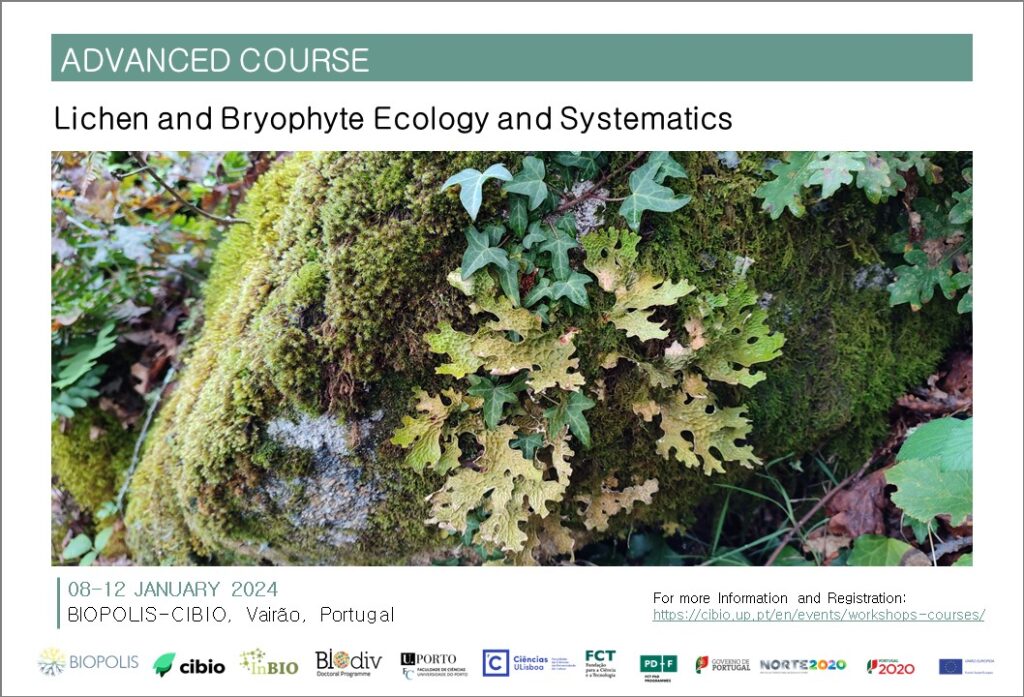
Through a combination of lectures, hands-on labs and field visits to local sites around the CIBIO-UP Campus, this course will cover major topics in lichen and bryophyte biology, ecology and evolution. An emphasis is placed on comparative lichen and bryophyte anatomy, morphology and structure as well as on ecologically key species, including those which may have important applications. Attendees are also given an overview of the incredible diversity of lichens and bryophytes and how these organisms evolved and interacted with the environment. Field visits will involve observing a range of (micro-)habitats where the specimens can be identified within their ecological context. Specimens may be taken back to the laboratory for examination and identification.

After successfully completing the course attendees are expected to:

• Understand the basic organization of the lichen and bryophyte bodies;

• Know how to collect specimens in the field and create a reference collection;

• Know how to use a lens in the field to look for characteristic structures;

• Know how to use lab equipment to analyse diagnostic structures in the lab;

• Recognize lichen and bryophyte cells, tissues and tissue systems;

• Identify basic types of lichen and bryophyte vegetative and reproductive structures;

• Interpret lichen and bryophyte structures and adaptations as responses to the environment;

• Thoroughly understand the lichen and bryophyte morphology terminology;

• Identify a selection of common species using a range of identification resources;

• Evaluate the role that lichens and bryophytes have as ecological indicators, and as reliable tools for monitoring and managing environmental changes;

• Be aware of the modern methods and approaches in biomonitoring, biodeterioration and bioprospection, and discuss how these have enhanced or changed classical approaches;

• Demonstrate knowledge in the current understanding of lichen and bryophyte phylogeny and evolution.

Application deadline: December 12, 2023

Click here for more details

PrevAnteriorPlantAnim Design Thinking Dec 18th
SeguinteESTUDO DA EVOLUÇÃO DA PAISAGEM URBANA DO PORTO FORNECE INFORMAÇÃO CHAVE PARA A CONSERVAÇÃO DE BIODIVERSIDADE URBANANext

Outras notícias

Decoding Alignment-Independent Retinal Regulatory Codes in Vertebrate Genomes

Yohei Ogawa, Molecular Life History Laboratory, National Institute of Genetics, Japan July 17, 2026 | 15h30 | CIBIO’s Auditorium and Online (Zoom Link) Homologous cell types have been

9 de Julho, 2026

Saving the Dinaric Eurasian lynx population from extinction

Magda Sindičić, Associate Professor, Faculty of Veterinary Medicine – University of Zagreb July 15, 2026 | 15h00 | Hybrid Seminar (Zoom Link) Central European populations of Eurasian lynx

1 de Julho, 2026

Como organizar eventos sustentáveis

Na sequência da publicação do “Guia sobre Como Organizar Eventos Sustentáveis” do CIIMAR, o Gabinete de Sustentabilidade Social e Ambiental irá organizar um seminário para

18 de Junho, 2026

Southeast Asian Biogeography Revisited: Alternative Mechanisms of Diversification and Dispersal

Justin Bernstein, American Museum of Natural History July 21, 2026 | 15h00 | Hybrid Seminar (Zoom Link) This presentation explores how geological and environmental processes shaped snake diversity

18 de Junho, 2026

Regulation of developmental plasticity in spadefoot toad larvae and its phenotypic consequences

Ivan Gomez Mestre, Estación Biológica de Doñana, CSIC June 17, 2026 | 10h30 | Hybrid Seminar (Zoom Link) Amphibians have evolved the greatest diversity of reproductive modes across tetrapods.

17 de Junho, 2026

Combining Physiology with Other Disciplines to Prevent Climate-Driven Wildlife Extirpation

Agustín Camacho, Facultad de Ciencias, Universidad Autónoma de Madrid June 17, 2026 | 15h00 | Hybrid Seminar (Zoom Link) Many different scientific disciplines and techniques claim to be key

12 de Junho, 2026
DEPARTAMENTO
  • Departamento
  • Instalações
  • Herança
  • Corpo docente
  • Corpo não docente
  • Contactos
  • Departamento
  • Instalações
  • Herança
  • Corpo docente
  • Corpo não docente
  • Contactos
ENSINO
  • Licenciaturas
  • Mestrados
  • Doutoramentos
  • Formação contínua
  • Licenciaturas
  • Mestrados
  • Doutoramentos
  • Formação contínua
INVESTIGAÇÃO
  • Áreas de Investigação
  • Centros Associados
  • Áreas de Investigação
  • Centros Associados
ESTUDAR
  • Estudar
  • Testemunhos
  • Estudar
  • Testemunhos
NOTÍCIAS E EVENTOS
  • Notícias e eventos
  • Biologia fim da tarde
  • Notícias e eventos
  • Biologia fim da tarde
LINKS ÚTEIS
  • Universidade do Porto
  • Faculdade de Ciências
  • DBIO Sigarra
  • NEBUP
  • Universidade do Porto
  • Faculdade de Ciências
  • DBIO Sigarra
  • NEBUP

© 2021 Departamento de Biologia da FCUP. Design by Glitz Design

Facebook-f Twitter Instagram Linkedin Youtube